05 October 2012

TTD - Tactical Texting Device (Concept)

 It has been a few days since my last post. Sorry about that. I see interest in my Chuck Box is very high. I will get a part 2 to the Chuck Box posted very soon. Thanks for the interest.

Now, something I have been toying with, in mind at least. A battlefield texting device. With the current popularity of texting and the attention that has been focused on the negative aspects - such as texting while driving. I felt we should look for a positive aspect of a mobile texting device. To which, I believe a battlefield use of this technology would be warranted. If you have ever had to perform OP (Observation Post) duty, with an enemy close by you know what I am talking about. You need to warn the CP (Command Post), however, the enemy is so close even whispering may expose your position. And you are out numbered and surrounded. 

What if, you could send that critical information to the CP without fear of compromising your location. Even better, you could deliver a running update of the enemy progress?? Sounds good, doesn't it.

Even with off-the-shelf technology, you should be able to assemble a Tactical Texting Device (TTD). You need a 4g type texting device with a keyboard. A WiFi packet type modem - that has a USB port to attach a memory device for caching messages. And a Portable or Vehicle 2-way radio that can be connected to the modem.

In an urban environment that has an operational cellular network in place, just use the 4g device on the cellular network. However, should the cellular network fail or does not exist, then use the WiFi ability of the 4g device in combination with the WiFi packet modem and the radio, thus creating a RF (Radio Frequency) Intranet or LAN (Local Area Network.)

I am not a techie, so this is just a concept from where I sit. A concept that should work with existing technology already out there. I just want to share this idea, so someone can take the idea and put it into practice. These devices are small and use very little power, so with the addition of a solar panel and a USB power cell, this concept should be field ready and self-sustaining. Use the solar system to recharge the 4g device, WiFi packet modem and the radio batteries.

If you are setting up any type of bug-out location remember to maintain some type of communication with your OP's. They are your early warning system. If you can achieve this without sound all the better.

Keep your batteries charged,

Mountainman.


May 2014 - UPDATE!!

Forget concept. Digital over radio communication is already happening.

Please follow this link to AmRRON and John Jacob Schmidt's article:


At least using the airwaves does come with a re-occuring monthly bill - like the internet or cable. Just an upfront fee to secure your HAM license. For more info on becoming a HAM radio operator visit: 

Remember receiving and having the ability to transmit information during a disaster or emergency is vital to your survival and success.

Mountainman.


05 September 2012

Long Term Shelter Options

 Long Term Shelter Options

Let's say you want to campout for a long time. More than a week, more than all summer, maybe forever.

Your cute $900 tent from North Face, Mountain Hardware, MSR, whomever may not be your first choice, first because you don't want to leave it behind - someone might steal it!!
So, what are your options? Build a cabin on Crown Land?? Might work, until the Ministry finds it and burns it to the ground. So, you are then seeking a  semi-permanent solution. Cabin-like comfort and tent like portability. 

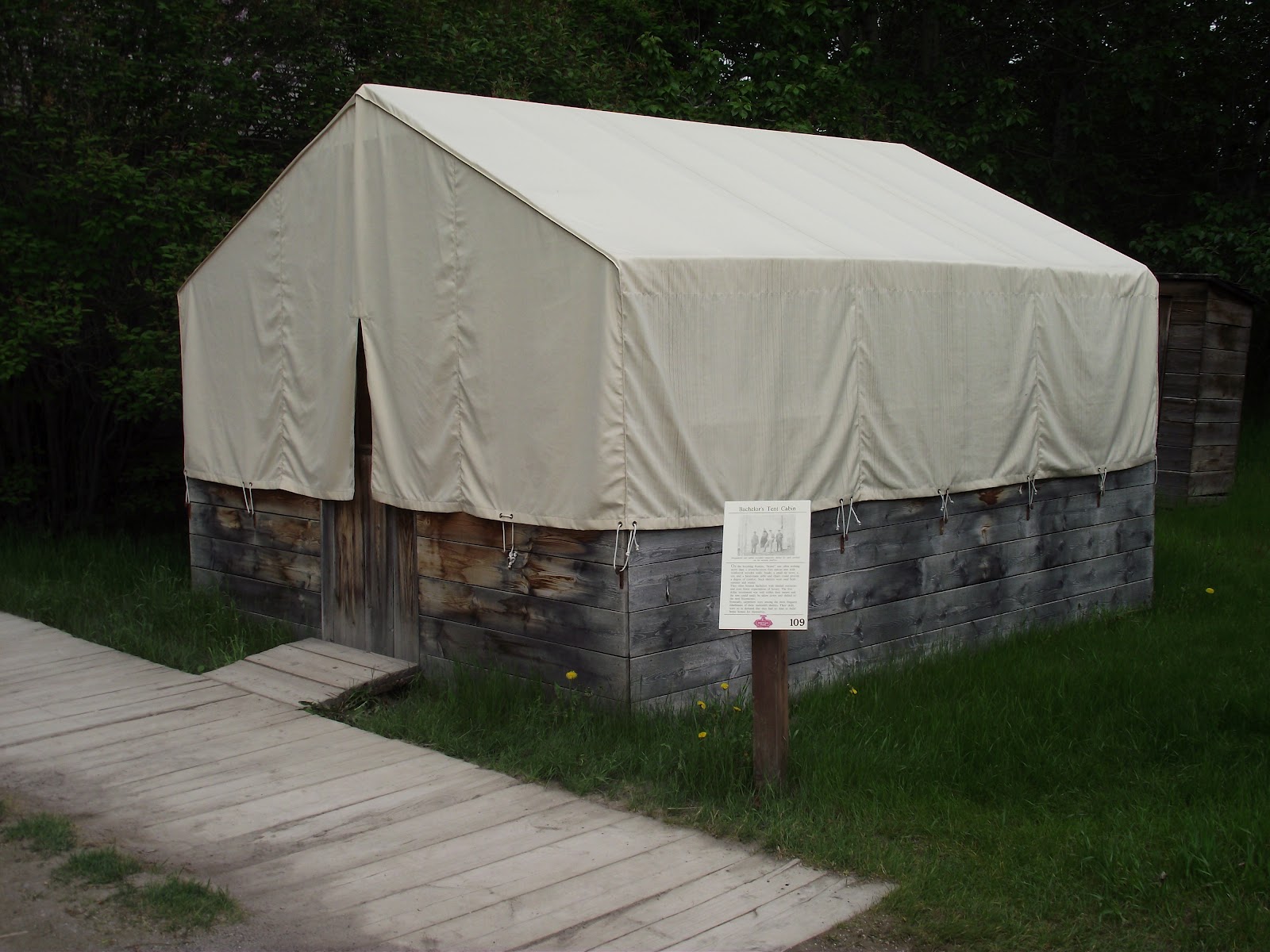
As you can see by the pictures, cabin tents are making a comeback. Lower down is a white canvas tent with wooden walls, these are the cabin tents of the late 1800's, used by ranchers, prospectors, gold-miners and hunters. The wood walls and floor keep the critters out and the canvas top keeps the weather out and the costs down.
 In my opinion, one of the best features of the cabin tent is the sturdiness. As long as you can keep the canvas tight and no oily fingers touch it, you get to stay dry. Also, these tents are big enough for cots, chairs, tables and even wood stoves. A small wood stove will keep a canvas tent warm even in the winter. The wood floor, makes you think you are in a house not a tent. Put a rug down and it is even more homey! For most canvas wall tents it would be best to have a large tarp strung over top. 1) To keep the water off and 2) to keep the UV rays from harming your home away from home.
Tents are not the only option. An RV can also work. The one pictured to the left has an add-a-room enclosure installed under the awning. This trailer is about 19 feet long and the add-a-room is about 10 feet long. Due to zip-out window covers, this addition is very weather proof. In fact, by adding it you now have another 80 square feet to live in. So, your washroom, kitchen and sleeping quarters are inside and your livingroom is outside. With a small propane or wood heater this setup could do for a year round setup. I would however, suggest that the RV have skirting installed, so, the wind cannot steal all the warmth from underneath the trailer - especially during the winter months.

This RV was setup in a public campsite, probably on a season's long rental agreement. A similar setup in the forest would work well if you had a location that had some form of security to protect it from vandalism when you were away. 

The BBQ is also a great addition to any campsite. When the weather is fine, why cook indoors. There is enough of that during the winter months.
The last pictures are of my wall tent setup a few years back. Yes, I had fun setting up camp, does it show?? Those tiki lamps can be a source of fire hazard, keep a fire extinguisher handy!

With just a tarp over our camp, our cots in the tent we were able to stay comfortable for our week long stay. My wall tent is a wee bit too small to setup as a cabin tent, it is only 8 feet by 10 feet. Enough space for 3 to sleep on cots. But, not much more space to live in. 
However, the addition of the large tarp over top, we had a safe and dry zone outside the tent if and when it rained.

The secret to semi-permanent camps is to keep the canvas tight. If. it can't flap in a breeze it can't get wrecked. 

Keep warm and Dry on your next outing!


Mountainman.

29 August 2012

Hiding In Plain Sight - Options For Building A Community

Blacksmith's Shop, L'Anse Aux Meadows, Nfld

Longhouse and other Buildings

Hiding In Plain Sight.

So, how do you hide a village? Why in plain sight of course. You just need to design your village to look like the surrounding area. Here are a few buildings, reconstructions of what things may have looked like around 1000 AD when the Vikings first arrived on Newfoundland. From the sea, this building style would have been very difficult to see, unless you know what to look for. With the rocks and small islands offshore most vessels would have keep at least a half kilometre from shore. From more than two kilometres without the aid of optical devices these buildings would be all but invisible to the naked eye.

How are they built? These are sod and timber framed structures. The walls are constructed from 2 foot wide strips of sod. The strips are laid with a 2 foot layer on the inside, with a 2 foot channel filled with gravel (for moisture management) and a final 2 foot strip on the outside. This makes a 6 foot thick wall. The walls are 4 to 5 feet tall and every three or so layers of sod, a 6 foot strip of sod is placed to tie the inner and outer layers together. The size of the building would dictate how many of these strips would be required for a given wall. The roof would be framed with available logs or timbers harvested and modified for the building being built. The roof would be "shingled" with sod to create a living roof. These building blend in with their environment because they are built from their environment. Sod is an excellent building material in locations where there is nothing.


Metalshop and Church, Norstead Village, Nfld
Having had a visit to these structures in both cold and warm weather I can speak to the thermal qualities. On a hot day the doors and roof vents are opened and the air flow helps to keep the buildings cool. Conversely, on wet, cool days with the doors closed and the vents almost closed and small fires lit, the building "feel" comfortably warm. Now, I was not there to visit in winter, but I will assume these building can maintain there thermal properties in winter as well.
Longhouse, Norstead Village, Nfld
Fort Beausejour/Fort Cumberland, NB
Example of a Good Defendable Location

Defendable Location, Opposite Side
The roof vents show once again the ingenuity of those who lived in the past. With a light wood frame, the intestine of a Walrus or similar sized animal was then stretched over the frame. Once dry the result was a waterproof, translucent skylight. So, not only could the Viking vent and adjust the temperature in their Longhouse they also had light. Natural light. These skylights saved a lot of resources such as whale oil, wood, coal or candles - by not having to have fires lit for light during the day. Resource management. Don't waste what you got, if you can devise another method to achieve the same results with less resources.  

Once you have mastered building a community with the resources available from the local environment consideration must be given to defence. An environmently friendly community is nice, but if you cannot protect it or defend it, you will lose it. The layout of your village is important. The location of your village is important. There are some "must have's" and some "nice to have's" that you will want inside the village. Water. You must have a source of water inside your village. It does not matter if it is a well, cistern, creek, spring or lake. You must have water. Food. You must have a supply of food. Food storage is good. Gardens are very good. Grain fields are nice, but unlikely to fit. Chickens for eggs and meat. Rabbits for meat. Goats or cows for milk, cheese, butter and meat. Sheep for wool and meat. These animals can live in a village with you. A source of heat for warmth or cooking. Firewood, coal, natural gas or even solar. Having a complete, stand-alone village is the goal. Self-sufficient and self-supporting. Working together for the common survival of all villagers.

However, once you have what other want you end up with problems arriving at your doorstep. So, you must be able to defend what you have. Of course, charity to those in need is necessary from time-to-time. And a supply of charitable goods should be on hand, but other are more ruthless. They do not want your kindness. They want to take everything away. They cannot be bought, unless the chains of your bondage to their slavery counts. To be defendable, you must locate your village so it can be defended. The last two pictures illustrate a possible defendable location. The large rock outcrop could be fortified with walls and shelters and one or two gates. The village itself could be located on the back side of the rock outcrop. A road to the water's edge would make sense, along with a wharf/dock, and a small port fortress. In an uncertain future that may have to re-learn the ways of olde. Villages will have to take care of themselves. Marauders will descend upon undefended villages and rape, pillage and plunder. The wolves will be out for blood, your blood. So, if you were to locate your village near this rock outcrop you will also want to have a flank security in the form of some sort of observation/listening posts that have communications with your village. AND an overwatch position on the hill behind your village.  This leaves the most likely approach by water. If your attackers do not have artillery or mortars you should have an above average likelihood of surviving hostile acts against your village.

Of course, for defence and resource procurement you will want to have patrols out at all times. Both on the water and in the hills.

If you do not have the skills to plan, build or design a village; now is the best time to gather some of the basic skills. Tomorrow may be too late.

Keep your head when others are losing theirs!

Mountainman.

25 August 2012

Can Quads be BOV's

Polaris RzR

Can quads, specifically, side-by-side ATV's be a Bugout Vehicle (BOV)?

I found this picture on the internet a few years back and I like what I see. Low centre of gravity. Robust suspension. And a reasonable sized engine. I believe this older RzR has a 600 or 650cc engine. 

In my opinion, you need to think in layers when it comes to Bugouts and Bugout Vehicles. If you have a F-350 Super-duty pulling a toyhauler trailer with a Polaris RzR inside and maybe a couple mountain bikes, too. Why would you want to leave your ATV at home?? You wouldn't. Take everything you can when you have to evacuate, as long as you can be on the road in minutes. Time matters. Pre-pack. Pre-load. Pre-position.

Of course, camo graphics or paint job go a long way to helping your quad blend in.

I will try to get more posts up in the next few days.

Mountainman.

26 July 2012

What I Have Seen On My Summer Roadtrip


Wow, what a roadtrip. All the way to Newfoundland!!

The first picture is a Mitsubushi Fuso?? 4x4 Camper RV unit I saw in the parking lot at L'Anse aux Meadows, Newfoundland. I thought it was a Unimog conversion at first. Notice the normal "C" Class motorhome parked next to it. Half the ground clearance and at least a foot taller.

The second picture is a cabin tent we saw tonight at a campground near Drummondville, QC. The tents are built by "Les Toiles Cabanon" from France.

I believe these two items would be good items to research for a personal BOV and first shelter at a BOL.

Well time is short and sleep is needed.

Keep your gear dry and ready,

Mountainman.

22 June 2012

Book Review of The G.O.O.D. Plan (Get Out Of Dodge)


Well, posting the excerpts of The G.O.O.D. Plan (Get Out Of Dodge) has resulted in a sale. AND a review of my book. I have posted the review here, with Susannah's permission. 
Have a great summer,
Mountainman.

Book Review "The G.O.O.D Plan"

Postby susannah755 » 18 Jun 2012 21:25
I recently purchased this book mainly because I'm an info junkie and the extracts that I saw on this forum whetted my appetite for more...so I made my move and purchased my copy. Best thing I ever did! I decided to write a review - I wasn't asked to write a review, I volunteered to do so only because when I read this book yesterday it just inspired me so much - it explained a lot than I simply did not know how to tackle, I had no plan for bugging out in an emergency as I was relying on a "by the seat of my pants" reaction...not any more, I've started my plan already, I have "direction" and it's giving me peace of mind. So...here's my review:

I really like the way this book was written, it was engaging and thought provoking throughout. (I honestly couldn’t put it down – I read the whole thing in one sitting). It is written using “lay-person” language so it is very easy to read and the advice given is simple and concise so, regardless of your level of knowledge in planning to bug out in an emergency, you will have a plan forming as you read this book.

The information contained in this work is enlightening – every base is covered and the author goes to great lengths to explain every aspect of how to begin to assimilate the idea’s contained within this tome into a workable plan for you and your family’s survival. There is a wealth of information on things that you would assume would be covered plus a whole lot more. I especially liked the drills/practice for bugging out, the use of family codes was awesome (something that I hadn’t even thought of), the lists that are included are fantastic, SOP’s are explained and the SERE tips are excellent. All of the information can be adapted to suit any climate in any country – bonus!! The additional resources are just “mind blowing”. This is a book that you will read again and again – a worthy addition to your survival bookshelf.

I would recommend that everyone read this book.
Thank you Mountainman - awesome effort.

So.....when is the next book coming out?

07 June 2012

The G.O.O.D. Plan (Get Out Of Dodge) Part 5


Morning,

Looks like my hissy-fit yesterday was for not. The problem with the highlighted text seems to be isolated to my PC. And I think my anit-virus program finally contained the problem, I hope. Nope, still infected. I hope it is just my machine. Enhanced text piss off. I know that probably did not work.

On to bigger and better things. I will make this post for The G.O.O.D. Plan (Get Out Of Dodge), and that may be it for the summer. I will, maybe, post more clips in the Autumn. I am still awaiting contact by possible publishers who may be interested in providing this book to the world. Please e-mail me at thegoodplan@hotmail.ca

I hope you enjoy this next segment.

Mountainman.


59.

Standard Operating Procedures (SOP's):

SOP's are just that, standard procedure for any given task. This is the way you and your family will always contact each other during an emergency, how you will pack up your vehicle and this is your procedure when you stop to refuel.

The military uses standardized procedures. This allows for a systematic conformity. In this case, conformity is a good thing. Because when the shit hits the fan and the bullets start flying, you don't want to waste a lot of time looking for someones first aid kit or spare ammo.

I would suggest your family establish SOP's for the following:

  • Contact/No Contact/LOST – Family Members
  • Family Codes – Password / Safeword
  • Start the G.O.O.D. Plan – codeword / codephrase
  • RV Location
  • Packing / Loading your G.O.O.D. Vehicle
  • Time – Always work backwards with the available time until you must Get Out Of Dodge!

Once you have your rough draft completed of your own G.O.O.D. Plan you may decide to add other SOP's.

For SOP's to work you must write them down ( in your G.O.O.D Plan .) You must practice them until they are second nature. And you must drill them from time-to-time to ensure you will remember them when the chips are down. If ,after all that, you notice you have SOP's for things that do not seem that important, you may want to edit and thin your SOP's to just the most critical procedures. The ones that get you out of your home and in your vehicle, so you can Get Out Of Dodge!

Now let's have a look at what your SOP's could look like. I will try to write up some SOP's that you can modify to fit your family's needs. Your list may include SOP's that I have not written samples for, do your best.
60.

Contact / No Contact / Lost Contact SOP:

  1. It is an emergency. You need to contact your family.
  2. If together, proceed to step 6.
  3. if apart. Call each person's cell phone first. Tell them where and when to meet up. Give your family codeword for starting the G.O.O.D. Plan.
  4. If unable to contact. Leave a message, use your codeword for starting the G.O.O.D. Plan. And instruct to call the contact person.
  5. Call your contact person. Leave the meeting location and time for other family members. Give today's password and the family safeword to your contact.
  6. Begin Packing the G.O.O.D. Vehicle, as per the G.O.O.D. Plan.
  7. Once packed or out of time, head for the meeting place. Try to be a couple minutes early if possible.
  8. Pickup all members of family, proceed to Safe Zone.
  9. IF, a family member does not make it to meeting place. Call your family contact. Get update. IF, they have not heard from overdue member, give alternate meeting place and time.
  10. Proceed to next meeting pace, enroute to Safe Zone. Call contact again. If, still no contact. Overdue member will have to use their own S.E.R.E. Plan to get to the Safe Zone on their own.

  • If you are the overdue member and you receive the message with the codeword to start G.O.O.D. You will:
  1. Immediately, call your family contact person
  2. Listen for the Family safeword and give the password of the day.
  3. You will ask for the meeting place and time. If you can not make it in time. Tell contact you are enroute. If possible to make it to the alternate meeting point in time say you link up there. If not possible, state I will be starting my S.E.R.E. Plan. See everyone at the Safe Zone. ETA – Unknown.
61.

  • If You loose contact with a family member after they know that the G.O.O.D. Plan is active, you will:
  1. Call your contact person. Update them. See if they have had any contact. If possible, arrange an alternate pickup point and time.
  2. Wait at the scheduled meeting point, for 10 minutes. If, still not contact – you MUST proceed without them. The members in your vehicle must get to the Safe Zone. You can decide to conduct a rescue mission after you arrive at the Safe Zone.
  3. Continue to check in with your contact person enroute to get updates.
  4. IF, your overdue member is close behind, you may make the decision to wait for link up.

  • If you loose contact with your family, after the G.O.O.D. Plan is active, you will:
  1. Establish communications with your family contact ASAP.
  2. You will update them on your situation.
  3. If link up is not possible in the time available, notify the contact you will be starting your S.E.R.E. Plan immediately.
  4. Meet at the Safe Zone when you can get there.

  • If you do not make contact with a family member. They may or may not know that the family G.O.O.D. Plan is in effect.
  1. You have already made it to the Safe Zone.
  2. You have not heard from you family member.
  3. Defence construction at the Safe Zone is under way.
  4. If the nature of the situation allows, you could try to drive a rescue mission to try to find your overdue family member. Or leave a message at a meeting location.
  5. Your Triage SOP should kick in. You should wait for your missing member to arrive following their S.E.R.E. Plan.
62.

Family Codes:

Passwords:

Passwords are a two part system. Part one the challenge word. Part two the password. Do's and Don't's:

  • Don't use colours
  • Don't use common pairs – romeo / juliette
  • Do use words your family will know
  • Do change your password often
  • Do change your password after it has been used
  • Do use your password before an emergency
  • Don't give the password if someone repeats the challenge word
  • Don't be afraid to keep a visitor separate until their identity can be verified
Sample:

  • 05 may 2011 Password of the Day = Tree/Leaf
  • Challenge is “TREE”
  • Response is “LEAF”
  • Any other response = open fire.

Safewords:

A safeword is a code word only someone who has been in contact with the family will know. This code is used to verify that the person is allowed to interact with the family. Such as:

  • Pick up child at school/camp/practice
  • Prove to the child that the person has had recent contact with the parent
  • give the child a ride

Although, child focused, this technique is equally applicable to adults or teenagers. This is a safety mechanism to verify authority when there is a time shortage.
63.

Safeword Do's & Don't's:

  • Do not give the safeword to non-family members just because.
  • Do ensure each member of the family knows the current safeword
  • Do remember a few old safewords – at least one
  • Do give the safeword to another when you need them to pickup your child
  • Do train your child to ask for the safeword before leaving an activity
  • do keep the family safeword safe
  • don't tell friends – At school, sports practice, or church ( not to anyone outside your family)

Safeword SOP:

  1. Each Family member knows current safeword
  2. You can not make it in time to pickup a family member
  3. You ask a friend to pickup family member. You give them the current safeword
  4. When the friend arrives at school/practice, the family member asks them for the safeword
  5. If correct, the family member knows it is okay to leave with them
  6. if, not correct or an old safeword, the family member will tell their teacher to call 9-1-1 and get the police. The family member will not leave with them.
  7. Better safe than sorry
  8. change safeword after it has been used
  9. Remember giving an old safeword is a message of distress.

Keep safewords posted in your home on a chaulkboard or whiteboard, that is out of sight of casual visitors. Update the board each time the safeword changes. Use safewords your family will know, understand and remember.

Keep Safe Out There!

67.

S.O.P.'s Parting Points

You will need to develop S.O.P.'s for all activities:

  • Activate G.O.O.D. Plan
  • Time – Evac Checklist
  • Packing/Loading G.O.O.D. Vehicle
  • Driving G.O.O.D. Route / Convoying
  • Refuel Point
  • Breakdown
  • Ambush
  • Road Blocks / Check points
  • Occupying Safe Zone
  • Defence Construction at Safe Zone
  • Contact Drills at Safe Zone
  • Recce Patrols
  • Going Home

This is a starting point. Your S.O.P's may be larger or smaller as you see fit. The more that is worked out before hand, the less stress when the bullets are flying and tasks need to be completed. Everyone needs a job. Everyone needs to know what their jobs is, and just do it.

Working with time:

Time is your greatest challenge during an emergency. So, it is important to have your evacuation checklist written in reverse order. That is, have the MOST important items listed first. IF, time permits then ....

If, you have 3 or more hours to evacuate, you can do quite a lot before you have to hit the road.

On the other hand

If, you only have 20 minutes to pack and get, a whole lot of your valuable gear and supplies will be left behind. This is a worthy point to ponder now as you build your G.O.O.D. Plan.